A space robot can look ready in a test room and still fail when dust, delay, or weak sunlight enters the job.
The advances worth watching are the ones that help robots work with less help from Earth and handle tasks that are hard to repeat by hand.
- Robots that repair, inspect, or move hardware without a nearby operator
- Machines that collect samples while preserving their location and condition
- Systems that keep working after dust, heat, glare, or a damaged sensor
Autonomy beyond a short command
On the Moon or Mars, a robot cannot rely on a person guiding every arm movement. Radio delay means commands may arrive late, while the surface can change between one image and the next.
The useful advance will be local decision-making. The robot needs to spot an object, plan a safe path, check its grip, and stop when the result looks wrong. That does not mean giving it free control. It means setting limits that keep a small error from becoming a lost mission.
A good test will show the full chain. It will include sensing, movement, contact, recovery, and a clear record of what the robot did when the first plan failed. A short clip of a moving arm proves far less.
Robots that work on real spacecraft
Space robots have often been linked to planned missions or controlled demonstrations. The next step is useful work around spacecraft, landers, habitats, and other equipment that people cannot reach easily.
Inspection is a practical starting point. Along a structure, it could inspect joints, read surface damage, and send images with their location attached. Repair is harder because the robot must work around fragile parts, changing light, and tight spaces.
The test that matters is repeatable contact. The system should find a target, place a tool, apply the right force, and confirm that the task finished. Force sensing matters here because a camera cannot tell the full difference between a tool that touched a bolt and one that missed it.
Machines that handle dust and rough ground
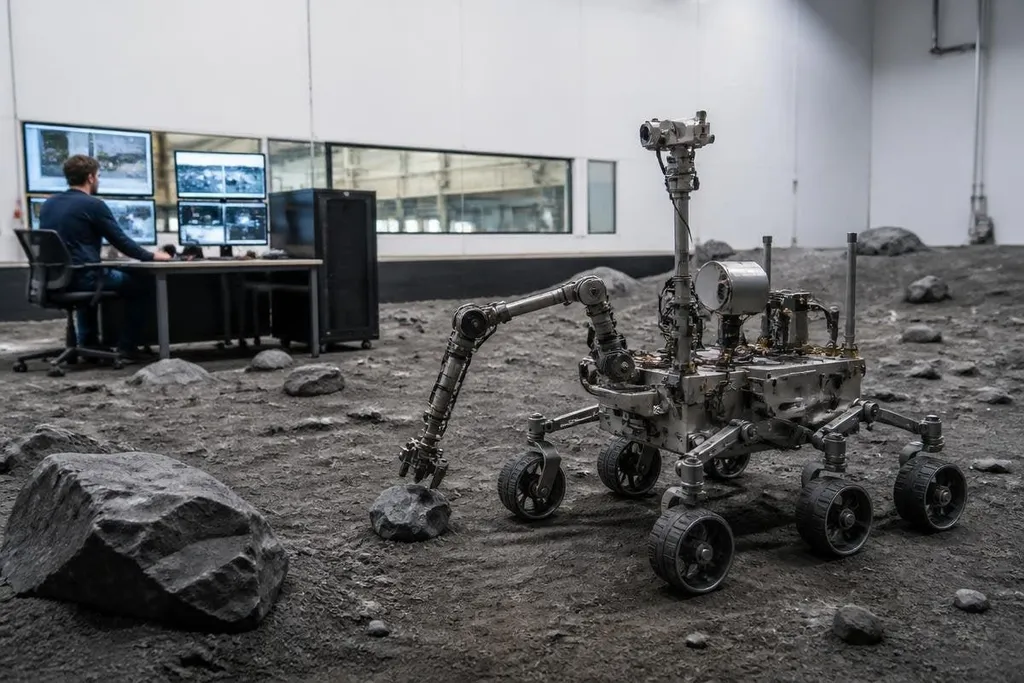
Surface robots face problems that do not appear on a clean floor. Loose soil can swallow a wheel, a rock can shift under a leg, and dust can cover a camera or enter a joint.
That makes movement a systems problem. Wheels, legs, suspension, motor control, and route planning must work together. A robot that moves well for ten minutes on a prepared patch has not yet proved it can cross a rough site for a full work period.
The best reports will include the ground type, slope, speed, distance, power use, and number of stops. They should also show what happened after a slip. Recovery tells you more than a clean run.
Dated space robotics coverage from Robot24.com puts the mission, test site, date, and result beside each claim. That record matters when sample handling turns a clean movement test into a science question.
Sample handling is where claims meet science
Collecting a sample is only half the job. The robot must keep the material separate, record where it came from, and avoid mixing dust from one site with another.
That calls for careful tool changes, sealed containers, image records, and clear control of each handoff. A sample system also needs a plan for failure. If a tube jams or a tool picks up less material than expected, the robot should report the problem and preserve what it has.
I'd rank sample handling above a polished driving demo. Returning a clean, well-labeled sample can answer a science question; crossing a test area has shown movement.
A practical test before you trust a claim
Use this checklist when a mission team or company announces a space robot advance:
- Name the task. Identify the exact job, not the broad goal.
- Check the setting. Look for real dust, rough ground, heat, glare, or low light.
- Find the operator limit. Ask how much work happened on Earth and how much happened onboard.
- Read the failure record. Look for slips, missed grips, blocked tools, sensor faults, and recovery steps.
- Check the result. Confirm that the robot produced a sample, repair, inspection record, or other useful output.
- Separate plans from results. A proposed mission and a completed test belong in different columns.
This filter also helps with cost and timing. A robot may have a sound design but still lack a launch date, flight hardware, or a public test under space-like conditions.
The next space robot breakthrough should be judged by the work it completes after the easy demonstration ends. Until a system shows repeatable sensing, contact, recovery, and useful output, the claim remains a test plan rather than a proven tool.